Stromal cell states in inflamed tissue
How inflammation pushes fibroblasts into disease-driving states, and whether those states can be reversed.
Question
In active Crohn’s disease, fibroblasts and other stromal cells change state. Where do these states come from, and are they stable?
Approach
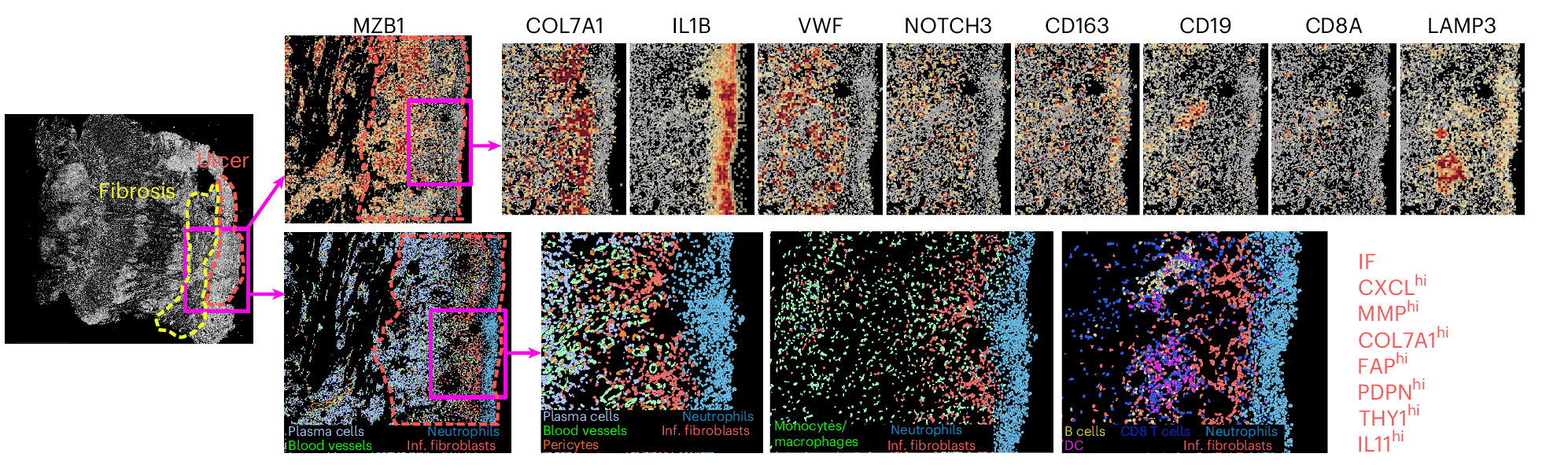
Spatial transcriptomics, RNA sequencing and chromatin accessibility (ATAC) sequencing of about 2.5 million cells from full-thickness Crohn’s disease bowel map 18 stromal cell states within their cellular and cytokine signalling environments. Comparing these states with fibroblasts from other tissues and diseases shows which programmes are shared and which are specific.
Why it matters
Inflammatory fibroblasts sit in immune-rich ulcers and are held in their state by a small set of transcription factors. They do not revert on their own, but blocking histone deacetylases destabilises them. Stromal cell states may therefore be open to epigenetic therapy.
People
- Simon Koplev PI

Related publications
-
Epigenetic modulation of stromal cell states underpins pathological tissue niches in Crohn’s disease. Nature Immunology (2026).
-
A single-cell and spatial genomics atlas of human skin fibroblasts reveals shared disease-related fibroblast subtypes across tissues. Nature Immunology (2025).
-
Universal and tissue-specific fibroblasts in chronic inflammation and cancer. Cancer Cell (2024).