Gene regulation and genetic risk in the heart
Placing inherited risk for cardiovascular disease in the specific cells and heart regions where it acts.
Question
Cardiovascular disease often starts in specialised regions of the heart, such as the valves or the pulmonary veins, that existing cell atlases cover poorly. Which cells in those regions carry genetic risk?
Approach
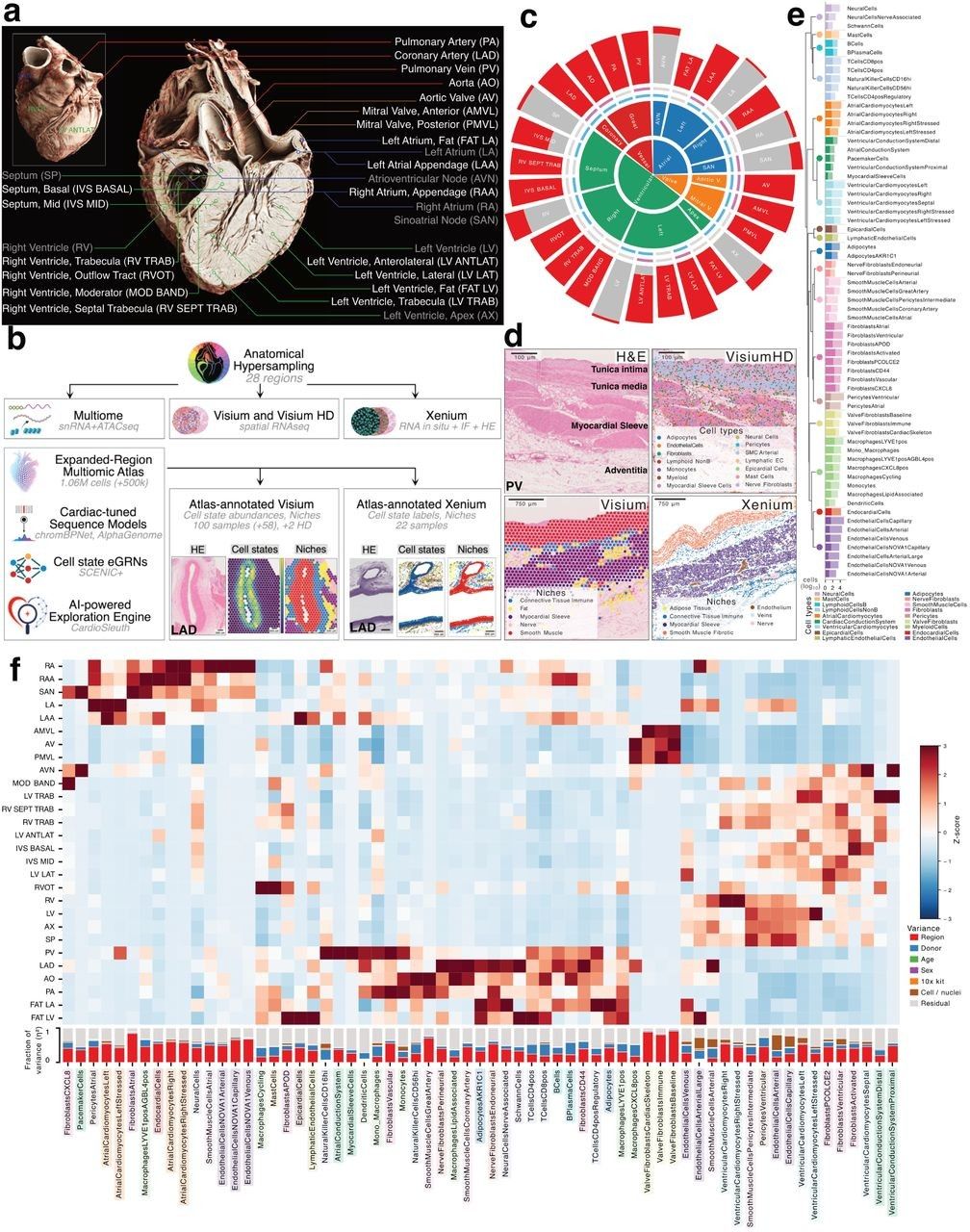
Twenty-eight regions of the adult human heart from 36 donors are profiled with paired single-nucleus RNA and chromatin accessibility assays and with spatial transcriptomics. Deep learning models fine-tuned to predict regulatory activity from DNA sequence then help read the effect of disease-associated variants in individual cell types.
Why it matters
The atlas links variants for atrial fibrillation, coronary artery disease and aortic valve stenosis to particular cell states. In one case, a variant’s effect in valve fibroblasts runs opposite to what bulk-tissue data suggest. The project builds on earlier work on gene regulatory networks in cardiometabolic and coronary artery disease.
People
- Simon Koplev PI

Related publications
-
Multimodal Hypersampling of the adult human heart resolves tissue-specific cell states and disease-associated variants. bioRxiv (Cold Spring Harbor Laboratory) (2026). Preprint
-
A mechanistic framework for cardiometabolic and coronary artery diseases. Nature Cardiovascular Research (2022).